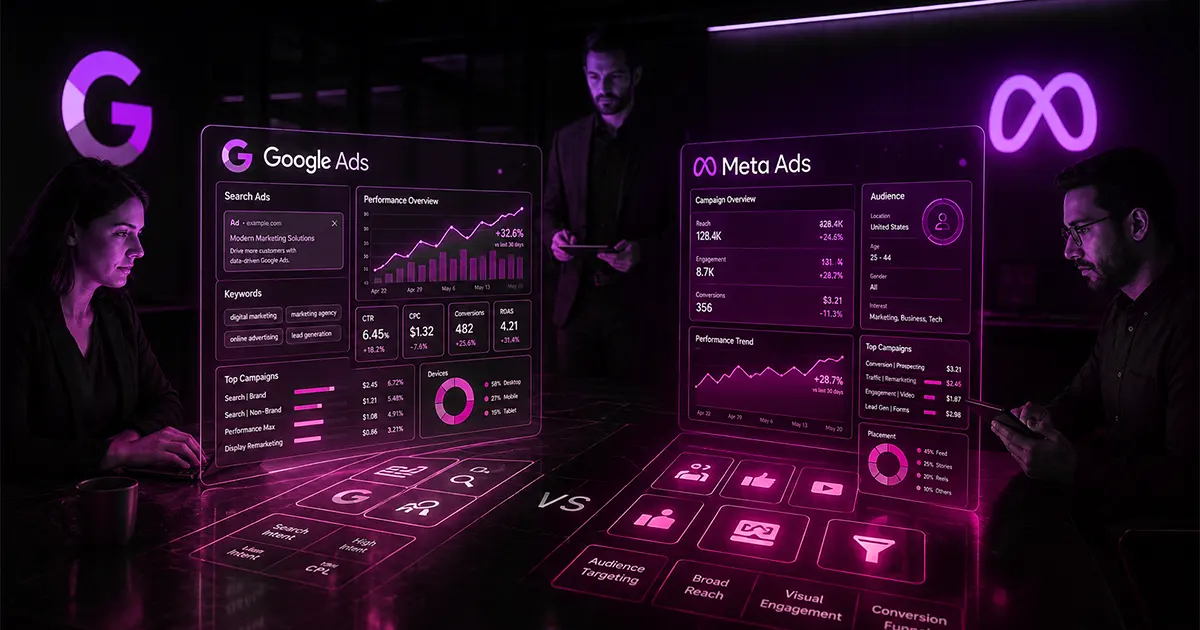
Google Ads and Meta Ads both work for GCC businesses, but they work differently.
Google Ads are stronger for capturing high-intent demand. These are people actively searching for a product, service, solution, clinic, consultant, agency, property, or provider.
Meta Ads are stronger for building awareness, creating demand, retargeting warm audiences, and staying visible with people who may not be searching yet.
For most businesses in Bahrain, Saudi Arabia, the UAE, and the wider GCC, the strongest results do not come from choosing one platform over the other.
They come from using both platforms with the right strategy, tracking setup, landing page, creative testing, and CRM follow-up system.
The real question is not, “Are Google Ads better than Meta Ads?”
The better question is, “Which platform is right for this audience, this industry, this budget, and this stage of the customer journey?”
At Divinare, this is how paid media is approached: not as isolated ad campaigns, but as part of an AI-powered growth system connected to SEO, CRM, creative, automation, and sales intelligence.
Quick Answer: Google Ads vs Meta Ads for GCC Businesses
Google Ads usually drive better leads when the audience already knows what they need and is actively searching for it.
Meta Ads usually perform better when the business needs to create awareness, build trust, show visual proof, promote offers, or retarget people who already interacted with the brand.
For GCC businesses:
Google Ads are stronger for:
- High-intent service searches
- B2B lead generation
- Local service discovery
- Healthcare, consulting, real estate, SaaS, and professional services
- Urgent or need-based searches
- Competitor comparison searches
Meta Ads are stronger for:
- Brand awareness
- Retargeting
- E-commerce and product discovery
- Lifestyle, wellness, beauty, retail, food, hospitality, and consumer brands
- Visual storytelling
- Offer testing
- Demand creation
The best strategy is usually a connected mix: Google captures demand, Meta creates and nurtures demand, and CRM automation helps convert the leads that come in.
Google Ads vs Meta Ads: The Core Difference
Google Ads are intent-led.
Someone types a search because they are looking for something. They may be looking for a marketing agency in Bahrain, a real estate project in Riyadh, a clinic in Manama, a SaaS solution, or a consultant for their business.
That search shows active intent.
Meta Ads are interest-led and behavior-led.
People are not usually searching inside Instagram or Facebook the same way they search on Google. They are scrolling, discovering, comparing, reacting, watching, and engaging.
That means Meta Ads often interrupt attention, while Google Ads capture existing demand.
Both roles matter.
Google helps you show up when someone is ready to search.
Meta helps you become familiar before they search, and helps you stay visible after they visit your website or engage with your content.
When GCC Businesses Should Use Google Ads
Google Ads work best when your target audience already knows they have a problem or need.
This makes Google especially valuable for high-intent searches in Bahrain and Saudi Arabia.
For example, a business owner searching “digital marketing agency Bahrain” is likely much closer to action than someone casually scrolling Instagram.
A clinic manager searching “healthcare marketing company Saudi Arabia” is already looking for a specific solution.
A buyer searching “apartments for sale in Riyadh” is showing direct commercial intent.
Google Ads are especially useful for these cases.
1. High-Intent B2B Services
Google Search Ads work well for B2B companies because decision-makers often use search when they need a specific provider.
This includes:
- Digital marketing agencies
- Consulting firms
- SaaS companies
- Legal and advisory services
- IT service providers
- HR and enterprise solutions
- Financial and professional services
For B2B businesses, Google Ads can help capture people who are already comparing options.
2. Local Service Businesses
Google Ads can be highly effective for businesses that serve customers in a specific city or country.
This includes:
- Clinics
- Wellness centers
- Real estate agencies
- Consultants
- Agencies
- Education providers
- Hospitality brands
- Local service providers
In markets like Manama, Riyadh, Jeddah, Dammam, and Dubai, local search intent can directly translate into inquiries, calls, WhatsApp messages, and bookings.
3. High-Ticket Services
For high-ticket services, Google Ads can justify higher cost per click because one qualified lead may be worth significantly more than the advertising cost.
This applies to:
- Real estate projects
- B2B SaaS
- Consulting services
- Healthcare services
- Enterprise solutions
- Specialized professional services
If the landing page, offer, and follow-up system are strong, Google Ads can drive high-quality inquiries from people already in buying mode.
4. Competitor and Category Searches
Google Ads also allow businesses to appear when people are searching for competitors, alternatives, or category terms.
This can be useful when a GCC business is trying to enter a competitive market and wants to appear alongside established providers.
However, this approach needs strong messaging and a clear reason for users to choose your brand.
When GCC Businesses Should Use Meta Ads
Meta Ads, including Facebook, Instagram, Messenger, and Reels placements, work best when visual storytelling, audience building, retargeting, and demand creation matter.
They are especially strong in GCC markets where Instagram and social discovery play a major role in brand perception.
Meta Ads are useful when the audience may not be actively searching yet, but can be influenced through strong creative, education, offers, and repeated exposure.
1. E-Commerce and Product-Led Brands
Meta Ads are often strong for e-commerce because product discovery is visual.
Fashion, beauty, food, wellness, home products, lifestyle products, and retail brands can use Meta Ads to show products in context and drive interest before the user searches on Google.
For e-commerce businesses, Meta Ads can support:
- Product discovery
- Retargeting
- Promotional campaigns
- Dynamic product ads
- Cart recovery
- Repeat purchase campaigns
- Seasonal offers
Meta can create demand that Google later captures.
2. Awareness Campaigns
If people are not yet searching for your product or service, Google demand may be limited.
Meta Ads help introduce the brand, explain the offer, build memory, and warm up audiences.
This matters for:
- New product launches
- New service categories
- Brand repositioning
- New clinics or centers
- SaaS platforms
- Hospitality offers
- Real estate launches
Meta helps the market understand why they should care before they actively search.
3. Retargeting Warm Audiences
One of Meta’s strongest uses is retargeting.
A person may visit your website, view a service page, engage with a social post, watch a video, or open a lead form without converting.
Meta Ads can bring that person back with a more relevant message.
For GCC businesses with longer buying journeys, retargeting can be especially important.
This includes real estate, consulting, healthcare, B2B services, SaaS, and professional services, where people often need multiple touchpoints before converting.
4. Visual and Trust-Led Industries
Meta Ads are highly useful when the decision is influenced by trust, lifestyle, design, aesthetics, results, social proof, or emotional connection.
This includes:
- Healthcare and wellness
- Beauty and aesthetics
- Real estate
- Hospitality
- Food and beverage
- Fitness
- Retail
- Personal brands
- Consumer services
In these sectors, the creative often matters as much as the offer.
Which Platform Works Better by Industry?
The better platform depends on the industry, audience, buying intent, and funnel stage.
Real Estate
For real estate marketing, both Google Ads and Meta Ads are important.
Google Ads capture active property searches, such as people looking for apartments, villas, investment properties, or projects in specific locations.
Meta Ads help build project awareness, show visuals, promote offers, retarget warm audiences, and create demand for off-plan or new developments.
Best approach: Use Google for high-intent search and Meta for awareness, retargeting, and project storytelling.
Healthcare and Wellness
For healthcare and wellness marketing, Google Ads work well for service-specific searches, such as clinics, treatments, procedures, specialists, or appointment-related queries.
Meta Ads help build trust through educational content, patient-friendly messaging, service awareness, and visual brand credibility.
Best approach: Use Google for appointment intent and Meta for trust-building and retargeting.
SaaS and Technology
For SaaS and technology marketing, Google Ads can capture high-intent searches around software categories, comparisons, pricing, integrations, and demos.
Meta Ads can support awareness and retargeting, but LinkedIn often becomes important for B2B decision-makers.
Best approach: Use Google for search intent, LinkedIn for B2B targeting, and Meta for retargeting and brand visibility.
Consulting and Professional Services
For consulting and professional services marketing, Google Ads help capture users searching for a consultant, advisor, or specific expertise.
Meta Ads are less likely to generate high-intent leads directly, but they can support retargeting, authority-building, and visibility.
Best approach: Use Google and LinkedIn for demand capture, then use Meta for retargeting and brand recall.
E-Commerce and Retail
For e-commerce and retail marketing, Meta Ads often play a stronger role in discovery and product promotion.
Google Shopping, Search, and Performance Max can capture purchase intent, while Meta helps introduce products and retarget shoppers.
Best approach: Use Meta for discovery and retargeting, Google for search and shopping intent, and CRM automation for repeat purchases.
Hospitality and Tourism
For hospitality and tourism marketing, Google Ads work well for booking-intent searches, such as hotels, resorts, destinations, and travel experiences.
Meta Ads help inspire travel decisions through visuals, packages, seasonal offers, and experience-led storytelling.
Best approach: Use Google for direct booking intent and Meta for inspiration, visual demand, and retargeting.
Why Tracking Matters More Than Platform Choice
Many GCC businesses do not fail because they chose the wrong platform.
They fail because tracking is weak.
If a business cannot identify which keywords, campaigns, creatives, audiences, and landing pages are producing qualified leads, it cannot optimize properly.
Clicks are not enough.
Form submissions are not enough.
A campaign should be judged by lead quality, sales conversations, booked calls, qualified pipeline, and revenue contribution.
Minimum tracking requirements for GCC paid advertising include:
- Google Analytics 4 conversion events
- Google Tag Manager setup
- Meta Pixel and conversion events
- WhatsApp click tracking
- Phone call tracking
- Form submission tracking
- CRM source tracking
- Lead quality scoring
- Sales outcome tracking
- Landing page performance review
This is where Marketing Automation and CRM Intelligence becomes essential.
Without CRM visibility, a campaign may look successful because it generated leads, even if those leads never became real opportunities.
How AI Improves Paid Campaign Performance in GCC Markets
Google and Meta advertising platforms increasingly use machine learning to optimize delivery, targeting, placements, and bidding.
This means campaign success depends heavily on the quality of inputs.
AI can only learn from the signals it receives.
For GCC businesses, strong inputs include:
- Clean conversion tracking
- High-quality creative variations
- Clear campaign objectives
- Strong landing pages
- Accurate CRM feedback
- Proper audience signals
- Clear offer positioning
- Fast lead follow-up
The role of the marketer is shifting.
Instead of manually controlling every small campaign adjustment, the strategist must design the system, define the conversion goal, feed the platform better data, test stronger creative, and connect advertising performance to real business outcomes.
This is the foundation of AI-Powered Performance Marketing.
The goal is not more platform activity.
The goal is better decision-making, stronger lead quality, and smarter budget allocation.
Budget Allocation: Google Ads vs Meta Ads
There is no universal budget split that works for every GCC business.
The right allocation depends on industry, current demand, brand awareness, funnel maturity, and sales cycle.
However, these principles can help.
- If the business has strong search demand, invest more in Google Ads.
- If the business needs awareness or product discovery, invest more in Meta Ads.
- If the business has website traffic but weak conversion, invest in retargeting and landing page optimization.
- If the business has lead volume but poor sales outcomes, invest in CRM automation before increasing ad spend.
- If the business has a long sales cycle, combine Google, Meta, LinkedIn, retargeting, email, and WhatsApp follow-up.
A useful starting point is not “Which platform should get more money?”
The better question is:
“Where is the current bottleneck in the customer journey?”
- If nobody knows the brand, Meta may need more budget.
- If people are searching but not finding the brand, Google may need more budget.
- If leads are coming in but not converting, CRM and follow-up may be the priority.
Paid Ads Checklist for GCC Businesses
Use this checklist before increasing ad spend.
- Conversion tracking is active in Google Analytics 4
- Google Tag Manager is installed correctly
- Meta Pixel and conversion events are configured
- WhatsApp clicks are tracked as conversion actions
- Phone calls and form submissions are tracked
- Landing pages load quickly on mobile
- Landing page message matches the ad promise
- Arabic and English audiences are separated where needed
- At least 5 creative variations are available for testing
- Retargeting audiences are built from website visitors and CRM lists
- CRM records the source and quality of each lead
- Sales teams respond quickly to new inquiries
- Campaigns are reviewed by CPL, lead quality, and pipeline, not only spend
- Budget is split between awareness, conversion, and retargeting where relevant
If these foundations are missing, increasing ad budget may only increase waste.
Common Mistakes GCC Businesses Make With Paid Ads
Mistake 1: Comparing Platforms Without Looking at Intent
Google and Meta are not the same type of platform.
- Google captures search intent.
- Meta creates and nurtures demand.
Comparing them without understanding funnel stage leads to poor decisions.
Mistake 2: Sending Paid Traffic to Weak Landing Pages
A strong ad cannot fix a weak landing page.
If the page is slow, unclear, generic, or missing trust signals, paid media performance will suffer.
Mistake 3: Tracking Leads but Not Lead Quality
A campaign that generates 100 weak leads is not better than a campaign that generates 30 qualified leads.
Lead quality matters more than lead volume.
Mistake 4: Ignoring Retargeting
Many users will not convert on the first click.
Retargeting helps bring warm audiences back with stronger proof, clearer offers, and more relevant messaging.
Mistake 5: Running Ads Without CRM Follow-Up
If leads are not followed up quickly, ad performance will decline no matter how strong the campaign is.
Paid ads need CRM, WhatsApp, email, and sales workflows behind them.
Final Verdict: Google Ads or Meta Ads?
Google Ads are better when the audience is actively searching.
Meta Ads are better when the brand needs awareness, visual storytelling, retargeting, and demand creation.
For GCC businesses, the best-performing strategy usually combines both.
- Use Google Ads to capture high-intent demand.
- Use Meta Ads to build awareness, retarget warm audiences, test creative, and nurture interest.
- Use CRM automation to follow up quickly.
- Use analytics to identify which platform produces better qualified leads, not just cheaper clicks.
- Use AI to optimize the full system over time.
That is how paid advertising becomes a growth engine rather than a monthly expense.
Conclusion
Google Ads and Meta Ads both have a place in GCC digital marketing.
The better choice depends on the audience, industry, offer, funnel stage, and conversion system.
For businesses in Bahrain, Saudi Arabia, the UAE, and the wider GCC, Google Ads are often stronger for high-intent searches, while Meta Ads are stronger for awareness, retargeting, and visual demand creation.
But the strongest results come when both platforms are connected through tracking, landing pages, creative testing, CRM automation, and sales follow-up.
The goal is not to win a platform debate.
The goal is to build a paid media system that brings in better leads, helps sales act faster, and improves over time.
To build a paid media strategy designed for your GCC market, explore Divinare’s AI-Powered Performance Marketing service or connect through Contact Divinare.
FAQs
Neither platform is universally better. Google Ads are stronger for capturing high-intent users who are already searching for a product or service. Meta Ads are stronger for awareness, retargeting, visual storytelling, and demand creation. Most GCC businesses perform best when both platforms work together with proper tracking and CRM follow-up.
For B2B lead generation in Saudi Arabia, Google Search Ads often produce stronger lead quality because they capture active search intent. For consumer brands, Meta, Instagram, TikTok, Snapchat, and video-led campaigns can generate stronger awareness and volume. The best platform depends on industry, audience, offer, and sales cycle.
Yes, Meta Ads can be effective in Bahrain, especially for consumer brands, healthcare, wellness, hospitality, retail, food, beauty, lifestyle, and retargeting campaigns. Bahrain is a smaller market, so creative quality, audience precision, and clear offers can have a major impact on results.
Yes, in many cases. Google Ads can capture people actively searching, while Meta Ads can build awareness and retarget those who engaged but did not convert. When both platforms are connected through CRM, tracking, and landing pages, they support the full customer journey more effectively.
Common reasons include broad targeting, weak landing pages, unclear offers, poor creative, slow follow-up, missing CRM tracking, and campaigns optimized only for cheap leads instead of qualified opportunities. Lead quality improves when ad strategy, landing pages, conversion tracking, and sales follow-up work together.
Budget split depends on intent and funnel stage. If people are actively searching for your service, Google Ads may deserve more budget. If the brand needs awareness, retargeting, or product discovery, Meta Ads may need more investment. The right split should be based on lead quality, CPL, pipeline value, and conversion outcomes.
At minimum, GCC businesses should track form submissions, phone calls, WhatsApp clicks, landing page conversions, Meta Pixel events, Google Analytics 4 events, and CRM lead sources. Stronger tracking should also measure lead quality, sales response time, booked calls, qualified pipeline, and revenue contribution.