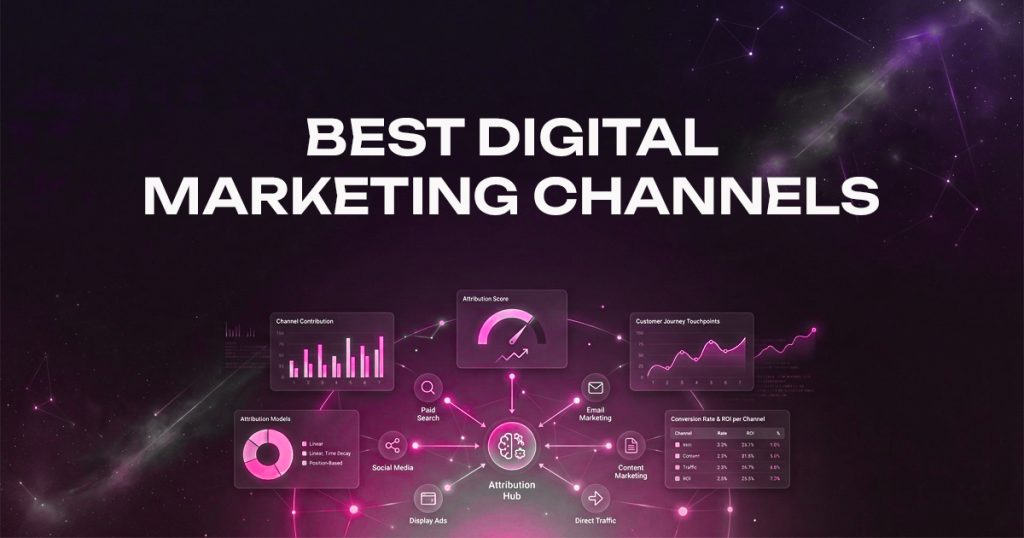
The best digital marketing strategy for GCC businesses in 2026 is not built around one channel.
It is built around a connected growth system.
SEO, paid advertising, social media, CRM automation, creative production, analytics, and AI must work together. For businesses in Bahrain, Saudi Arabia, the UAE, and the wider GCC, the goal is no longer just online visibility. The goal is to turn attention into qualified leads, booked calls, demos, inquiries, purchases, and closed sales.
This matters because digital competition across the GCC is becoming more sophisticated. Buyers are more informed. Platforms are more crowded. Ad costs are harder to control. Search behavior is changing. AI is reshaping how customers discover, evaluate, and trust brands.
In this environment, isolated marketing activity is not enough.
A business may run ads but lose leads because follow-up is slow. It may rank on Google but fail to convert because the landing page is weak. It may post on social media but struggle to connect content with real business outcomes.
The strongest GCC brands in 2026 will not simply do more marketing.
They will build smarter marketing systems.
At Divinare, this means combining AI-powered performance marketing, predictive SEO, social media intelligence, CRM automation, and creative automation into one connected growth model for GCC businesses.
Quick Answer: What Is the Best Digital Marketing Strategy for GCC Businesses?
The best digital marketing strategy for GCC businesses combines SEO, paid advertising, social media, CRM automation, conversion-focused creative, and AI-powered decision-making into one system.
SEO builds long-term visibility. Paid ads capture immediate demand. Social media builds trust and awareness. CRM automation improves follow-up and lead nurturing. Creative automation helps brands test and scale content faster. AI connects the system by helping teams predict demand, optimize campaigns, personalize journeys, and make better decisions.
For Bahrain, Saudi Arabia, and UAE businesses, the most effective strategy is not channel-first.
It is customer-journey-first.
What Makes GCC Digital Marketing Different?
GCC digital marketing operates in a distinct environment shaped by mobile-first behavior, bilingual Arabic-English audiences, WhatsApp communication, high social media influence, and rapid private-sector growth.
Bahrain’s digital economy direction focuses on digital transformation, stronger digital services, skills development, and connectivity, while Saudi Arabia continues to position data and AI as part of its Vision 2030 transformation agenda.
For marketers, this means GCC strategies cannot be copied directly from Western markets.
Several realities shape digital performance in the region.
- WhatsApp is a key contact channel. In many B2B and B2C sectors, buyers expect to message a business directly before booking, purchasing, or requesting a quote. Funnels without WhatsApp or fast follow-up often lose warm leads.
- Arabic and English search intent can differ. A person searching in Arabic may have a different buying mindset, urgency, or location preference than someone searching in English. Both need thoughtful keyword research, content structure, and landing page strategy.
- Trust signals carry significant weight. GCC buyers often look for local understanding, case studies, client proof, clear service positioning, reviews, and strong brand presence before they engage.
- Seasonal and cultural cycles matter. Ramadan, Eid, National Day campaigns, shopping seasons, exhibitions, tourism cycles, and industry events can affect messaging, budget allocation, creative direction, and campaign timing.
Understanding these market realities is the starting point.
Building a system around them is the competitive advantage.
The 5 Core Channels Every GCC Business Should Prioritize
A complete digital marketing strategy for GCC businesses in 2026 should include five connected components.
Each one can produce results on its own, but the real value appears when they work together.
1. Predictive SEO and Content Intelligence
SEO remains the foundation of long-term digital growth.
When someone in Riyadh searches for a business solution, or a decision-maker in Manama searches for a local service provider, the brand that appears with the clearest answer earns attention first.
But SEO in 2026 is not only about ranking for keywords.
It is about understanding intent, building topical authority, answering real questions, and preparing for AI-driven search experiences.
For GCC brands, predictive SEO means identifying what customers are likely to search next, not only what they searched last year. It means building content around high-intent commercial searches, local market needs, service-specific questions, and industry-specific buyer journeys.
A Bahrain business may need service pages that clearly explain local relevance, trust signals, and conversion paths. A Saudi business may need content strategies that account for Riyadh, Jeddah, and Dammam search behavior separately. A GCC-wide brand may need content that explains regional service capability across multiple markets.
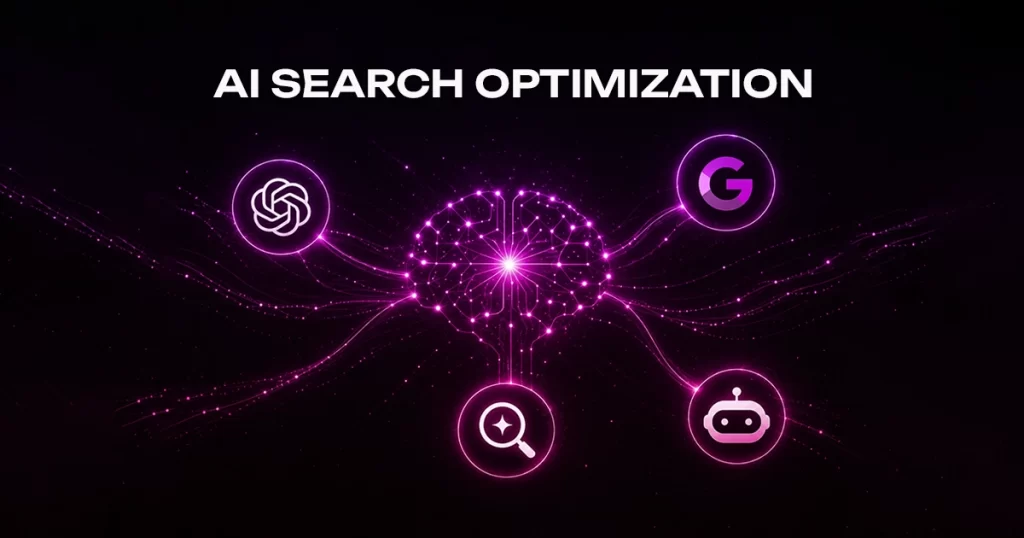
With Predictive SEO and Content Intelligence, businesses can move beyond reactive keyword targeting and build content systems that support visibility, AEO, GEO, and lead generation.
2. AI-Powered Performance Marketing
Paid advertising is essential for capturing demand that already exists.
Google Search, Meta Ads, TikTok, Snapchat, YouTube, and LinkedIn can all play a role depending on the industry and audience.
But in GCC markets, paid traffic without conversion infrastructure is wasted spend.
The brands that perform well are not always the ones with the highest budgets. They are the ones with stronger audience targeting, tested creative, better landing pages, conversion tracking, CRM follow-up, and a clear understanding of lead quality.
Paid ads should not only generate clicks.
They should generate qualified opportunities.
That requires clear campaign structure, platform-specific targeting, conversion-focused landing pages, message testing, and fast follow-up.
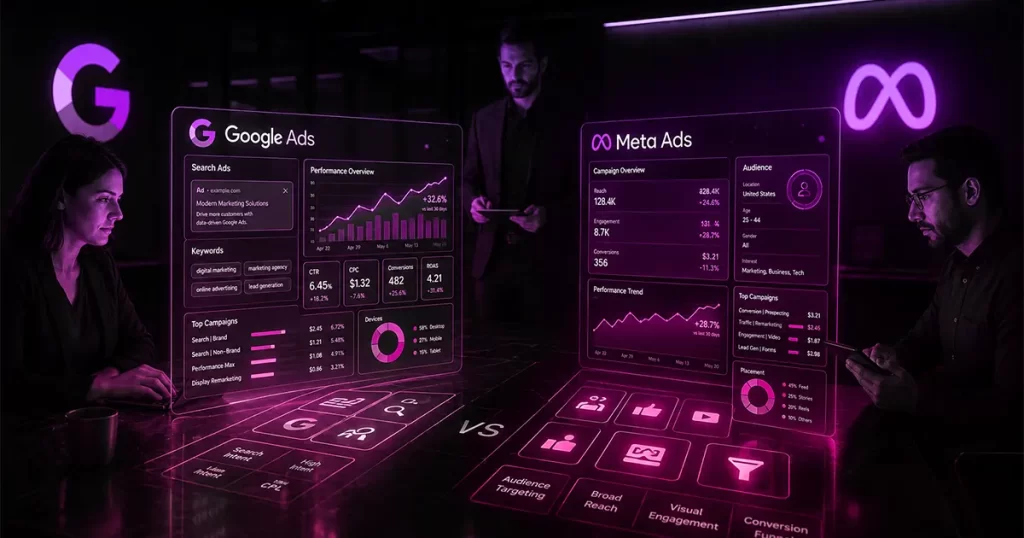
With AI-Powered Performance Marketing, GCC businesses can use AI-led targeting, campaign testing, conversion tracking, creative learning, and budget optimization to reduce waste and improve lead quality.
Paid ads answer immediate demand.
SEO builds long-term demand capture.
Both are necessary. Neither replaces the other.
3. AI-Driven Social Media Management
In the GCC, social media plays a major role in discovery, trust, and conversion.
Instagram, LinkedIn, TikTok, Snapchat, and YouTube are not just content platforms. They are often the first place customers experience a brand’s personality, credibility, and relevance.
- For B2B businesses in Bahrain and Saudi Arabia, LinkedIn can be critical for reaching decision-makers, founders, executives, and professional buyers.
- For consumer brands, Instagram, TikTok, Snapchat, and short-form video often shape awareness and product interest.
- For healthcare, wellness, consulting, and professional services, educational content helps build trust before conversion.
The key is not posting for the sake of activity.
The key is building a social media system informed by audience behavior, content performance, platform format, and business objectives.
With AI-Driven Social Media Management, brands can move beyond content calendars and use data-led planning, audience intelligence, creative production, and engagement insights to build consistent demand and brand memory.
4. Marketing Automation and CRM Intelligence
The gap between many GCC businesses and their competitors is not lead generation.
It is lead follow-up.
A business may generate inquiries from ads, SEO, social media, referrals, and website forms, but if those leads are not followed up quickly and consistently, the opportunity is lost.
This is especially important in GCC markets where WhatsApp is often a preferred communication channel.
Marketing automation and CRM intelligence help businesses respond faster, qualify leads better, and track every touchpoint from first inquiry to closed sale.
A strong system may include WhatsApp automation, email nurture flows, lead scoring, CRM pipelines, internal sales alerts, appointment reminders, and follow-up sequences.
For example, a real estate developer running paid ads without structured follow-up may lose prospects to competitors that respond faster. A clinic receiving website inquiries may miss appointments if leads are not nurtured. A SaaS business may lose demo opportunities if sales and marketing data are not connected.
With Marketing Automation and CRM Intelligence, businesses can turn fragmented leads into structured journeys.
Automation is not a luxury in 2026.
It is growth infrastructure.
5. Creative Automation and Design AI
Creative is often the difference between a campaign that converts and one that gets ignored.
It affects whether an ad earns attention, whether a social post builds trust, whether a landing page feels credible, and whether a brand stays memorable.
In 2026, GCC businesses need more than attractive visuals.
They need creative systems that can produce, test, refine, and scale.
Creative automation helps brands develop multiple ad variations, social media assets, landing page visuals, short-form videos, campaign concepts, and localized creative formats faster.
But the real value is not speed alone.
The real value is performance feedback.
When creative production is connected to audience data, campaign results, and conversion signals, brands can identify which messages, visuals, and formats deserve more investment.
With Creative Automation and Design AI, GCC brands can produce faster while staying aligned with brand identity, audience expectations, and performance goals.
Why SEO Alone Is Not Enough for GCC Growth
A common mistake is treating SEO as a standalone growth strategy.
The logic seems simple: rank on Google, get traffic, generate leads.
In reality, SEO depends heavily on what happens after the click.
If the page loads slowly, the message is generic, the offer is unclear, the CTA is weak, or the WhatsApp option is missing, rankings may not convert into business results.
SEO creates visibility and intent-led traffic.
But conversion requires stronger landing pages, persuasive service content, trust signals, lead capture, retargeting, and CRM follow-up.
The businesses getting the strongest results from SEO in Bahrain, Saudi Arabia, and the wider GCC are not treating SEO as a traffic tactic. They are treating it as the top layer of a full conversion system.
Explore Divinare’s Work page to see how structured digital strategy supports business outcomes.
Why Paid Ads Need CRM and Follow-Up Automation
Paid advertising in GCC markets can generate demand quickly, but the lead experience after the click determines whether the campaign becomes profitable.
A common pattern is simple.
The ad works. The lead arrives. No one follows up fast enough.
By the time the business responds, the prospect may have already contacted competitors.
Speed-to-lead is one of the most important conversion variables in service-based, B2B, real estate, healthcare, consulting, and high-consideration markets.
Marketing automation solves this by triggering immediate WhatsApp messages, email responses, internal sales alerts, CRM updates, and follow-up sequences.
This turns paid media from a cost center into a growth system.
Paid ads bring the lead in.
CRM automation helps move the lead forward.
How to Build a GCC Marketing Funnel That Converts
A strong GCC marketing funnel in 2026 includes four connected stages.
Stage 1: Awareness
This is where the brand reaches the right audience before they are ready to buy.
Useful channels include SEO blog content, social media, video content, paid awareness campaigns, industry insights, and thought leadership.
The goal is to become visible before the customer enters active comparison.
Stage 2: Consideration
This is where the buyer starts comparing options.
Useful assets include service pages, industry pages, case studies, Google Search ads, LinkedIn content, retargeting campaigns, FAQs, and educational resources.
The goal is to become the most credible and relevant choice.
Stage 3: Conversion
This is where the customer takes action.
Useful tools include WhatsApp CTAs, contact forms, consultation booking pages, free audits, lead magnets, demo requests, and clear service offers.
The goal is to make the next step low-friction and easy to complete.
Stage 4: Retention
This is where marketing continues after the first conversion.
Useful systems include CRM follow-up, email sequences, customer education, social retargeting, loyalty campaigns, upsell journeys, and performance reporting.
The goal is to turn one-time buyers or leads into long-term customers and advocates.
Most businesses already have part of Stage 3: a contact form, phone number, or WhatsApp button.
The bigger opportunity is building Stages 1, 2, and 4 around it.
Industry-Specific Digital Marketing Strategy for GCC Businesses
A strong strategy should change based on the industry.
- A real estate marketing strategy should focus on buyer intent, property demand, lead quality, campaign timing, and CRM follow-up.
- An e-commerce and retail marketing strategy should focus on product visibility, paid performance, conversion journeys, abandoned cart recovery, repeat purchase behavior, and customer lifetime value.
- A healthcare and wellness marketing strategy should focus on trust, patient education, local SEO, appointment journeys, and responsible communication.
- A SaaS and technology marketing strategy should focus on demo generation, product-led growth, user acquisition, funnel clarity, and lead nurturing.
- A consulting and professional services marketing strategy should focus on authority, thought leadership, LinkedIn visibility, decision-maker trust, and long-cycle lead nurturing.
- A hospitality and tourism marketing strategy should focus on seasonal demand, direct bookings, traveler intent, guest journeys, and loyalty.
This is why digital marketing cannot be generic.
The right strategy must match the audience, market, decision cycle, and business model.
GCC Marketing Strategy Checklist for 2026
Use this checklist to assess where your business stands today.
- Location-specific pages for Bahrain, Saudi Arabia, UAE, or GCC markets
- SEO-optimized service pages with clear commercial intent
- Industry-specific landing pages for priority sectors
- Active Google Business Profile where local search is relevant
- Paid ad campaigns with proper conversion tracking
- WhatsApp or fast-response lead follow-up system
- CRM pipeline connected to lead sources
- Email or WhatsApp nurture sequence for non-converted leads
- Social media content aligned with business objectives
- Creative testing across ads, social, and landing pages
- Case studies, testimonials, or client proof
- Arabic and English content strategy where relevant
- Monthly performance review across CPL, ROAS, organic traffic, lead quality, and conversion rate
If fewer than half of these are in place, the business likely has a major gap between current performance and what a connected digital growth system can achieve.
What GCC Businesses Should Prioritize First
Not every business should start with the same channel.
- If the business needs leads immediately, start with paid ads, landing page optimization, and CRM follow-up.
- If the business has long-term growth goals, start building SEO and content authority immediately.
- If the business has strong visibility but weak conversion, improve website messaging, CTAs, trust signals, and CRM automation.
- If the business has inconsistent branding or poor ad performance, start with creative testing and content systems.
- If the business has complex B2B sales cycles, prioritize LinkedIn, thought leadership, CRM intelligence, and lead nurturing.
The best strategy is not the one that uses every channel equally.
It is the one that identifies the biggest growth bottleneck and builds the right system around it.
Conclusion
The best digital marketing strategy for GCC businesses in 2026 is not about choosing between SEO, ads, social media, CRM, or AI.
It is about connecting them.
SEO creates long-term visibility. Paid ads capture immediate demand. Social media builds trust. CRM automation improves follow-up. Creative automation increases testing speed. AI helps the entire system learn faster and make better decisions.
For businesses in Bahrain, Saudi Arabia, the UAE, and the wider GCC, the opportunity is clear.
The brands that grow stronger will be the ones that stop treating marketing as disconnected activity and start building intelligent growth systems.
To build a digital marketing strategy shaped for your GCC market, explore Divinare’s AI-powered services or connect with the team through Contact Divinare.
FAQs
The best digital marketing strategy for GCC businesses in 2026 combines SEO, paid advertising, social media, CRM automation, conversion-focused creative, and AI-powered decision-making. These channels should work together as one connected system. The goal is not only visibility, but qualified leads, faster follow-up, stronger trust, and measurable business growth.
For many businesses in Bahrain and Saudi Arabia, Google Search, Meta, LinkedIn, Instagram, TikTok, Snapchat, YouTube, WhatsApp, and SEO can all play important roles. The best channel mix depends on the audience. B2B businesses often need LinkedIn, SEO, and CRM automation, while consumer brands may need Instagram, TikTok, Snapchat, paid ads, and strong creative.
Most GCC businesses should run paid ads and SEO together if budget allows. Paid ads can generate leads quickly, while SEO builds long-term organic visibility and reduces dependency on paid traffic over time. If the business needs immediate leads, start with paid ads and conversion tracking. If the business needs sustainable visibility, build SEO from the beginning.
AI improves digital marketing by helping businesses identify audience patterns, predict demand, test creative faster, optimize ad budgets, personalize follow-up, and improve content planning. In GCC markets, AI can help brands respond faster to changing customer behavior, reduce wasted spend, improve lead quality, and make better marketing decisions.
CRM automation is important because many leads are lost after the first inquiry. GCC buyers often expect fast responses through WhatsApp, email, or direct contact. CRM automation helps businesses respond quickly, qualify leads, trigger follow-up sequences, track sales progress, and improve conversion from paid ads, SEO, social media, and website inquiries.
Many GCC businesses benefit from both Arabic and English content, especially when targeting mixed audiences. Arabic and English users may search differently, respond to different messaging, and need different landing page experiences. The right language strategy depends on the market, service, audience segment, and buyer intent.
A GCC business can start by auditing its current customer journey. Review SEO visibility, paid ad tracking, landing pages, social media content, CRM follow-up, WhatsApp response time, and conversion rates. Then identify the biggest bottleneck. The best first step is usually the area where the business is already losing the most potential leads.